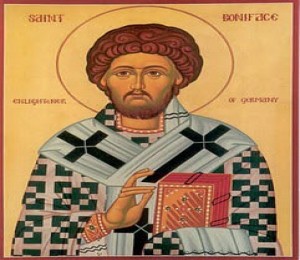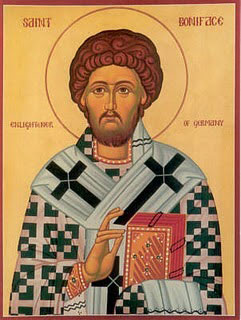
Born around 675 in Wessex, England, Saint Boniface, originally named Winfrith, became one of the greatest missionaries in Church history and is remembered as the "Apostle of Germany." Raised in a Christian family, he felt drawn to religious life from a young age after meeting visiting monks. Despite his father’s initial opposition, Winfrith entered the monastery school at Exeter and later continued his studies at the Benedictine monastery of Nursling, where he became known for his intelligence, holiness, and skill as a teacher.Though respected as a scholar and priest in England, Winfrith believed God was calling him to missionary work among the pagan peoples of northern Europe. In his early forties, he left the comfort of monastic life and traveled to Friesland (modern-day Netherlands) to assist the missionary Saint Willibrord. His first mission ended in disappointment when the pagan ruler Radbod violently persecuted Christians and drove missionaries from the region. Forced to return to England, Winfrith could have abandoned his calling, but instead he learned an important lesson: zeal alone was not enough. Missionary work required preparation, unity with the Church, and spiritual authority.Determined to continue his mission, Winfrith traveled to Rome to seek the blessing of Pope Gregory II. Impressed by his devotion and wisdom, the pope officially commissioned him as a missionary to the Germanic peoples in 719. At this time, he received the name Boniface, likely in honor of an early Christian martyr. Boniface would remain deeply loyal to the papacy throughout his life, helping strengthen the bond between Rome and the growing churches of Europe.Boniface first worked in Thuringia and later in Hesse, regions where paganism and superstition remained widespread. One of the most famous moments of his missionary work occurred near Geismar, where he confronted the worship of Thor by cutting down a massive sacred oak tree dedicated to the false god. The people expected divine punishment, but when nothing happened, many recognized the powerlessness of their pagan gods and converted to Christianity. Tradition says the oak split into four parts as it fell, forming the shape of a cross.As the Christian faith spread, Boniface worked tirelessly to organize and reform the Church throughout Germany and the Frankish kingdoms. He founded monasteries, established dioceses, and called councils to correct abuses among clergy and strengthen Church discipline. One of his greatest foundations was the Abbey of Fulda, which became a major center of learning and evangelization in Europe. He also encouraged many monks and nuns from England to join him in missionary work, helping build a strong Christian culture across the region.In 732, Pope Gregory III named Boniface an archbishop, and later he became Archbishop of Mainz. From there he continued leading missionary efforts and reforming the Church with wisdom, courage, and fidelity to Rome. Despite his age and many accomplishments, Boniface never stopped preaching the Gospel.Near the end of his life, Boniface returned once more to Friesland to evangelize the people there. In 754, while preparing a group of converts for Confirmation near Dokkum, he and his companions were attacked by armed pagans. Refusing to allow his followers to fight back, Boniface encouraged them to trust in God and embrace martyrdom if necessary. He was killed alongside many companions while holding a book of the Gospels.Saint Boniface is honored as a martyr, missionary, and reformer who helped bring Christianity and Christian civilization to much of Germany and western Europe. His feast day is celebrated on June 5. He remains a powerful example of perseverance, courage, obedience to the Church, and unwavering faith in Christ.


 Spiritual Category
 Religious Category